
During my first year of teaching, quarterly exams exposed a practical challenge. I needed test items that reflected what I had actually taught. Each question had to align with lesson objectives. That requirement led me to the Table of Specifications (T.O.S.) and Bloom’s Taxonomy.
A Table of Specifications functions as a test blueprint. It maps topics against test items. This process keeps assessments balanced and aligned with learning goals. It prevents overemphasis on one area while ignoring others. Bloom’s Taxonomy supported this work by breaking objectives into clear cognitive levels. Action verbs clarified whether tasks required recall, application, or analysis.
This process reinforced the value of precise objectives. Objectives guided lesson flow, informed activity design, and provided a clear reference for tracking learner progress.
reflective approach to Bloom’s taxonomy
Earlier academic exposure framed Bloom’s Taxonomy as a required tool rather than a practical one. Objectives stayed basic. Definitions and recall tasks dominated. The broader implications remained unclear.
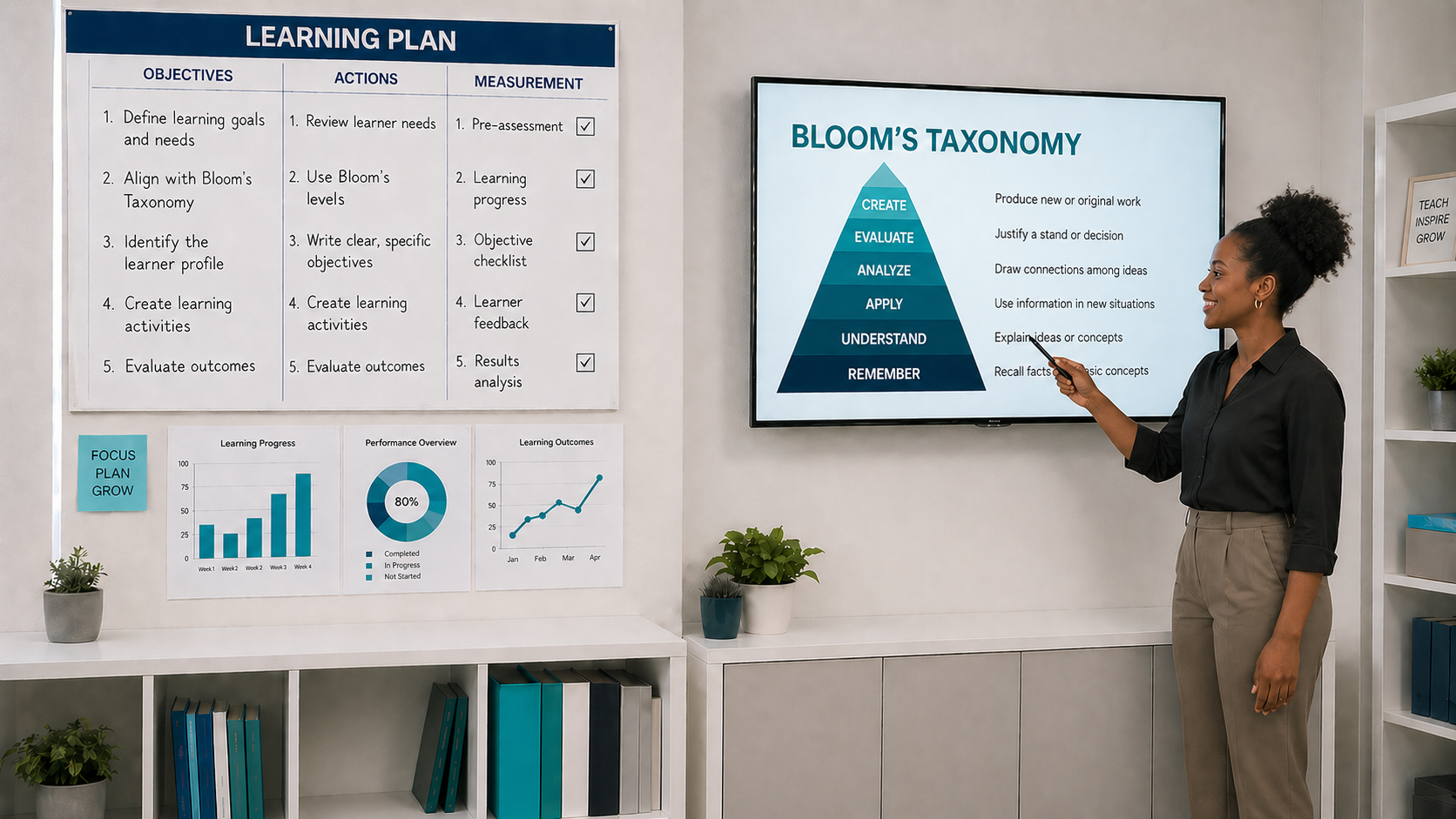
Teaching experience changed that view. Bloom’s framework clarified how objectives influence thinking depth. I revised how I wrote goals.
I once used objectives such as “Mauunawaan ng mga mag-aaral ang mga pangunahing pangyayari sa Cold War.” The statement sounded acceptable yet remained vague. Applying Bloom’s levels led to clearer outcomes, such as “Susuriin ng mga mag-aaral ang mga sanhi at bunga ng mga pangunahing kaganapan sa Cold War at ang epekto nito sa modernong lipunan.” This shift directed learners toward analysis and connection. Classroom discussions improved. Students articulated ideas with more structure and confidence.
Learning extended beyond memorization. Bloom’s taxonomy provided language that supported thinking progression.
Bloom’s Taxonomy in Practice
Bloom’s Taxonomy continues to support my instructional design work. It sustains clarity and depth across learning contexts. Writing objectives through this framework strengthens precision and accountability.
In professional learning settings, Bloom’s taxonomy prevents vague direction. Instead of asking learners to understand a process, objectives call for analysis, evaluation, and proposal of improvements. This difference moves learning toward application.
Bloom’s Taxonomy remains relevant across contexts. It supports clear thinking in environments saturated with distractions and derivative material. The framework anchors instruction in proven practice. It helps produce learning experiences that promote reasoning, application, and informed judgment.