
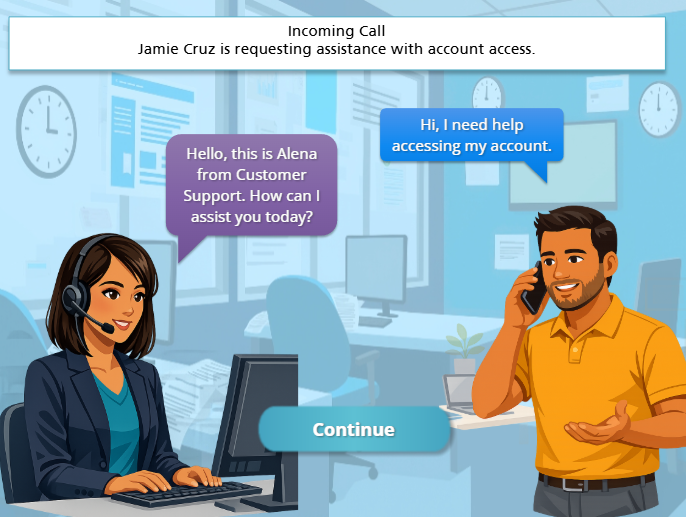
This lesson includes a short interactive scenario where learners practice customer verification during a simulated customer call.
The activity serves as guided practice within the lesson before the final readiness check. Learners review customer requests, select the correct response, and receive immediate feedback that reinforces safe handling of customer information.
| Category | Details |
|---|---|
| Project Type | Scenario-based eLearning lesson with an interactive customer verification simulation |
| Audience | Customer service representatives handling inbound customer calls and account support requests |
| Delivery Mode | Instructor-led training session with an embedded interactive eLearning activity |
| Duration |
Full training session:45 minutes Interactive simulation activity: 5 minutes within the session |
| My Role | Instructional designer, Learning experience proposal designer, lesson planner, simulation designer, content developer |
| Tools Used | Articulate Storyline 360, Canva for scenario-based design workflow, Adobe illustration |
| Key Skills Demonstrated | Learning experience design, scenario-based learning, decision-based interaction design, training flow planning, performance-based assessment design |
Overview
This interactive simulation is part of a structured lesson within a data protection training session designed for customer support teams. The lesson focuses on applying customer verification procedures during live customer interactions.
The simulation appears after learners review verification rules and common risks in earlier lessons. It serves as a guided practice activity where learners apply procedures in realistic call scenarios before completing a readiness check in the next lesson.
Learners take the role of a customer service representative and respond to customer requests across multiple decision points. Each decision requires the learner to select the safest action while protecting customer information and following verification procedures.
This activity lasts five minutes within a forty-five-minute training session. The short duration supports focused practice without interrupting the overall training flow.
The lesson prepares learners to apply verification procedures consistently before transitioning to live customer handling responsibilities.
see more…
The Need
Customer service representatives handle sensitive customer information during routine interactions. Errors during verification can expose personal data and create compliance and service risks.
Common challenges include:
- Responding quickly when customers request faster service
- Maintaining verification procedures during high-pressure interactions
- Recognizing when customer information does not match records
- Following escalation procedures consistently
Short refresher training strengthens correct behavior and reduces risk during everyday customer interactions.
Target Learner Persona
Customer service representatives who handle inbound customer calls and provide account support.
Typical characteristics include:
- Responsible for verifying customer identity before providing support
- Expected to follow established verification procedures
- Working in fast-paced service environments
- Making real-time decisions during customer interactions
Learners already know the process. They benefit from guided practice that strengthens consistent performance during live calls.
Lesson Context
This simulation is delivered as part of a structured lesson sequence designed to prepare learners for real customer interactions.
The lesson progression moves from knowledge review to guided practice and readiness confirmation.
Lesson sequence:
Lesson 1 — Introduction to data protection responsibilities
Lesson 2 — Verification and disclosure procedures
Lesson 3 — Common risks and mistakes during customer interactions
Lesson 4 — Guided practice through an interactive verification simulation
Lesson 5 — Final readiness check and reinforcement
The simulation supports Lesson 4. It provides structured practice before learners complete the readiness check in Lesson 5.
Learning Goals
By completing this lesson activity, learners will:
- Apply the correct steps to verify customer identity
- Maintain verification procedures during customer requests
- Recognize situations that require escalation
- Select safe responses during customer verification scenarios
These goals focus on performance during real customer interactions, not memorization of policy details.
Learning Experience Design
This lesson uses scenario-based practice to strengthen decision-making during customer verification.
Learners progress through a simulated customer call that mirrors real work conditions. Each screen presents a customer request that requires the learner to select the correct response.
The lesson design includes:
- Realistic customer dialogue and call flow
- Multiple decision points that reflect common work situations
- Immediate feedback after each response
- Consistent interaction layout across screens
The five-minute simulation provides focused practice while maintaining the pacing of the full training session.
This design supports guided practice before learners complete the final readiness check in the next lesson.
Lesson Activity Flow
The simulation follows a simple decision-based sequence that mirrors a real customer call.
Welcome Screen
Introduces the activity and explains the learner’s role.
Objective Screen
Clarifies the actions learners will practice during the call.
Scenario Setup
Introduces the customer and the reason for the call.
Decision 1 — Initial Verification
Learner selects the correct response to begin verification.
Decision 2 — Customer Pressure Situation
Learner maintains verification procedures when the customer requests faster service.
Decision 3 — Verification Confirmation
Learner confirms verification steps before providing account support.
Completion Screen
Reinforces safe verification behavior and confirms readiness to continue training.
Assessment Strategy
The simulation functions as a practice-based performance check within the training session.
Learners receive immediate feedback after each decision. Incorrect responses trigger corrective feedback and allow the learner to retry the step.
This approach supports skill development during the lesson and prepares learners for the final readiness check at the end of the session.
The readiness check confirms that learners can apply verification procedures consistently before handling live customer interactions.
My Role
I designed and developed this lesson activity as part of a structured training solution for customer support teams.
My responsibilities included:
- Analyzing the performance gap related to verification procedures
- Designing the lesson flow and decision sequence
- Writing realistic customer dialogue and feedback messages
- Building the interactive simulation in Articulate Storyline
- Testing navigation and learner interaction flow
- Ensuring the activity supports readiness before live customer handling
Outcome
This lesson activity provides structured practice that prepares learners to apply verification procedures during customer interactions.
Expected performance outcomes include:
- Improved decision-making during customer verification
- Stronger consistency in following verification procedures
- Increased readiness for live customer handling
- Reduced risk of unsafe information handling
The lesson connects training directly to daily customer support tasks and supports consistent performance during real customer interactions.