
Feedback & Leadership Simulator
I built this Twine branching scenario prototype to test a realistic leadership conversation before investing in higher-effort eLearning development, visual production, and complex authoring.
- Interactive branching conversation
- Five to ten minutes
- First-time team leads and junior managers
Project overview
This simulator gives new leaders a low-risk place to practice a difficult performance conversation. Learners choose what to say during a feedback meeting and see how tone, timing, and clarity affect the employee’s response.
The scenario follows a high-performing employee whose missed deadlines signal declining engagement. Across three decision points, the learner opens the conversation, responds to defensiveness, and closes with—or without—clear next steps.
Twine made it possible to test the conversation as a working web prototype. Stakeholders could click through each path, compare consequences, and review the dialogue before any high-effort eLearning production began.
Twine is an open-source tool for creating interactive, nonlinear stories that publish directly to HTML. Learn more on the official Twine website .
- Project type
- Interactive branching scenario prototype
- Audience
- First-time team leads and junior managers
- Delivery mode
- Self-paced web-based simulation
- Duration
- Five to ten minutes
- My role
- Instructional designer, scenario writer, conversation mapper, and prototype developer
- Tools
- Twine and Google Docs
The leadership problem
Newly promoted team leads often know they need to address poor performance but struggle with the conversation itself. Some avoid direct feedback. Others speak too forcefully and trigger defensiveness, confusion, or disengagement.
A slide-based lesson could explain a feedback model. It could not give leaders practice choosing their words when the employee reacts emotionally. The learning experience needed consequences, retries, and room to compare different ways of responding.
Learners and context
The learners are early-career managers who moved into leadership from individual contributor roles. Many have limited formal leadership training and little time for long courses.
- Fast-paced work with competing priorities
- Remote and hybrid team conversations
- Pressure to protect morale while improving performance
- Real-time decisions during emotionally charged discussions
Learning goals
- Deliver clear, behavior-focused feedback.
- Respond constructively to emotional reactions.
- Choose language that supports accountability.
- Close the conversation with specific next steps.
Why use a branching scenario?
Leadership communication depends on judgment. One response changes the employee’s reaction and affects what the leader needs to say next. A branching scenario makes that relationship visible.
Learners can test a dialogue choice, experience the consequence, replay the conversation, and notice how small changes in tone and phrasing affect trust, clarity, and accountability.
Sustainable eLearning starts before production
Branching scenarios can become expensive to revise once screens, graphics, media, animations, states, and accessibility work are already in production. I used Twine first to test the part that mattered most: the decisions and their consequences.
Test logic before polish
Every decision path could be reviewed while the experience was still quick and inexpensive to change.
Reduce avoidable rework
Dialogue, consequences, and outcomes could be revised before visual production locked them into multiple screens.
Build only what earns its place
The prototype showed which branches supported the goals and which choices added complexity without useful practice.
Create a production blueprint
The approved Twine flow can guide later eLearning development without rebuilding the conversation map from memory.
This makes the workflow more sustainable in practical terms: less discarded production work, faster review cycles, clearer scope, and a stronger basis for deciding if a full eLearning build is justified. No environmental savings were measured for this prototype.
Twine branching scenario prototype build process
I kept the workflow centered on the conversation, branching logic, and evidence needed before a larger build.
Plan the scenario
I selected a familiar workplace problem: a high-performing employee had started missing deadlines as engagement declined.
Map the conversation
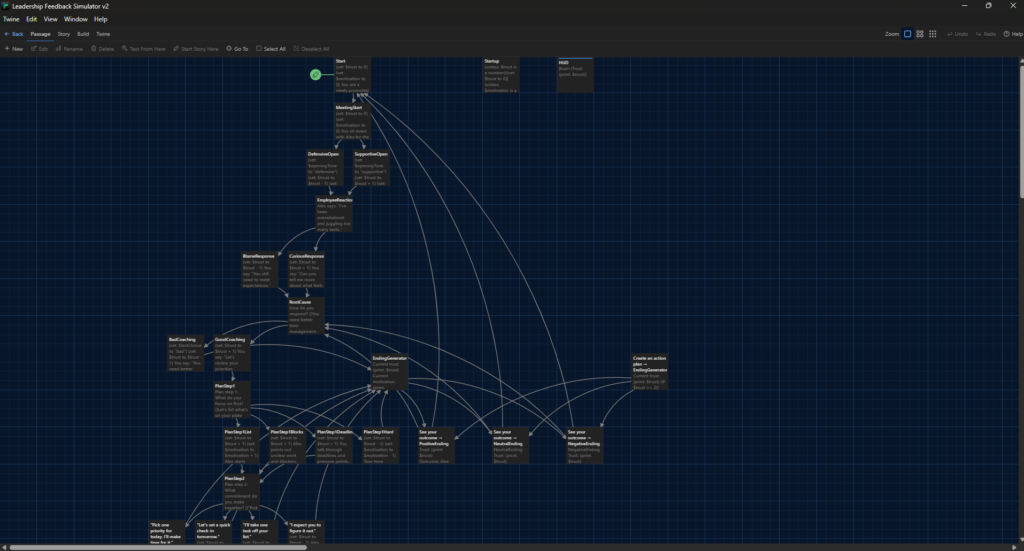
I planned three decision points, two branching reactions per decision, and four distinct outcomes.
Write the dialogue
I wrote defensiveness, emotional pushback, clarifying questions, and tone shifts that sounded plausible at work.
Build and test in Twine
I linked every passage, replayed each route, removed dead ends, and refined the consequence messages.
Conversation structure
Each decision changes the employee’s reaction and moves the learner toward one of four conversation outcomes.
Open the conversation
- Direct and structured opening
- Vague general comment
- Emotionally charged opener
Respond to defensiveness
- Active listening and clarification
- Escalation and pressure
- Dismissive reply
Close the conversation
- Clear next steps and agreement
- Ambiguous expectations
- Authority-based directive
Possible outcomes
- Trust strengthens and both people agree on an action plan.
- The employee complies without genuine engagement.
- Tension increases and the employee disengages.
- The conversation breaks down before clear next steps emerge.
What the prototype validated
- Every decision leads to a relevant employee reaction.
- All routes reach a complete outcome without dead ends.
- The four outcomes remain distinct and traceable to learner choices.
- The full experience stays within a five-to-ten-minute session.
Design challenges
- Writing natural dialogue that still teaches the target skills
- Keeping realism without creating branch overload
- Connecting every path to the learning goals
- Giving useful feedback without interrupting the conversation
The prototype confirms that the branching logic and conversation flow work as intended. It does not yet provide learner-performance or workplace-outcome data. Those measures belong in a pilot with the target audience before a larger production build.
Try the conversation before the full build.
Click through the working Twine prototype, test different responses, and see how each decision changes the conversation.
If the main link does not open, use the direct prototype file .