
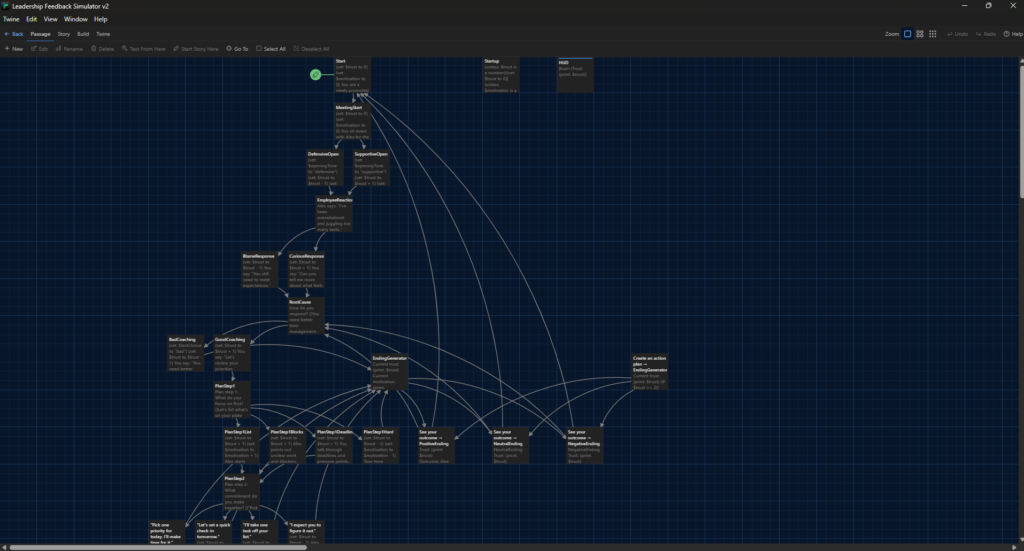
Try the Interactive Prototype
This is a working Twine prototype. Click through the conversation and try different responses to see how the scenario changes.
Alternative URL: Feedback Simulator
| Category | Details |
|---|---|
| Project Type | Interactive branching scenario simulation |
| Audience | First-time team leads and junior managers |
| Delivery Mode | Self-paced web-based simulation |
| Duration | 5–10 minute interactive scenario |
| My Role | Instructional designer, scenario writer, conversation mapper, prototype developer |
| Tools Used | Twine (prototype), Genially (production), Google Docs (script writing) |
| Key Skills Demonstrated | Scenario-based learning design, branching logic mapping, dialogue writing, decision-based learning design, prototype testing |
Overview
This simulator helps new leaders practice performance feedback in realistic conversations. Learners choose responses during a feedback meeting and see how tone, timing, and clarity change the employee’s reaction and the outcome.
read more…
The Problem
Newly promoted team leads often struggled to give direct, respectful feedback. Some avoided tough conversations. Others delivered feedback in a way that triggered defensiveness, confusion, or disengagement.
Slide-based training explained feedback models, yet it did not give leaders a place to practice real dialogue. Leaders needed a low-risk practice space where small wording choices produced clear consequences.
Learner and Context
The learners are early-career managers in a growing organization. Most moved into leadership from individual contributor roles and had limited formal leadership training.
Context details:
• Fast-paced work environment
• Limited time for long training sessions
• Remote and hybrid teams
• Pressure to protect morale while improving performance
The simulation needed to stay concise, feel realistic, and connect to day-to-day conversations.
Learning Goals
After the simulation, learners will be able to:
• Deliver clear, behavior-focused feedback
• Respond to emotional reactions during feedback conversations
• Choose language that supports accountability
• Close the conversation with specific next steps
Why a Branching Scenario?
Leadership communication demands judgment and quick decisions.
A branching scenario lets learners:
• Make real-time dialogue choices
• Experience emotional and professional consequences
• Replay the conversation to improve outcomes
• Notice how tone and phrasing affect trust
This format matches real feedback conversations where each response changes what happens next.
Design Process
Scenario Planning
I selected a common workplace issue: a high-performing employee started missing deadlines due to declining engagement.
I planned three core paths:
• Supportive yet vague feedback
• Harsh and overly direct feedback
• Balanced and effective feedback
Each path shows effects on trust, motivation, and clarity.
Conversation Mapping
I mapped the experience to keep choices meaningful.
Flow design:
• 3 main decision points
• 2 branching reactions per decision
• 4 possible outcomes
The map avoided cosmetic branching and ensured each choice changed the conversation dynamic.
Script Development:
I wrote workplace dialogue that mirrors real reactions:
• Defensiveness
• Emotional pushback
• Clarifying questions
• Tone shifts across the conversation
Each choice triggers an immediate employee reaction. The scenario ends with a short reflection prompt and a summary of what the learner’s choices signaled.
Build and Testing in Twine:
I built the prototype using Twine passages and links.
Work included:
• Linking decision paths
• Tracking tone shifts across branches
• Testing all routes for broken links and dead ends
• Refining consequence messaging
I replayed every pathway multiple times to verify continuity and clean logic.
Scenario Structure:
Decision Point 1: Opening the conversation
• Direct and structured opening
• Vague general comment
• Emotionally charged opener
Decision Point 2: Responding to defensiveness
• Active listening and clarification
• Escalation and pressure
• Dismissive reply
Decision Point 3: Closing the conversation
• Clear next steps and agreement
• Ambiguous expectations
• Authority-based directive
Outcomes
• Trust strengthened, and an action plan created
• Compliance without engagement
• Increased tension and disengagement
• Conversation breakdown
Key Design Features
• Immediate consequence simulation through employee reactions
• Replay option to test alternatives
• End-of-scenario reflection summary
• Concise, dialogue-driven interface built for short sessions
Challenges
• Writing dialogue that felt natural while still teaching key skills
• Avoiding branch overload while keeping realism
• Keeping every path tied to the learning goals
• Delivering feedback without breaking immersion